
Autumn 2 · Week 2 · Lesson 1 · Monday 9 November 2026
Learn and keep your part
I can learn a four-beat part and repeat it with a steady pulse.
I can follow the count-in and start on beat 1.
I can keep each rest as long as a tap.
I can repeat my part twice without speeding up.
You can tap softly, point, sign, speak, draw or write. Ask for a pause or a quiet space. Follow the stop cue.
Knowledge organiser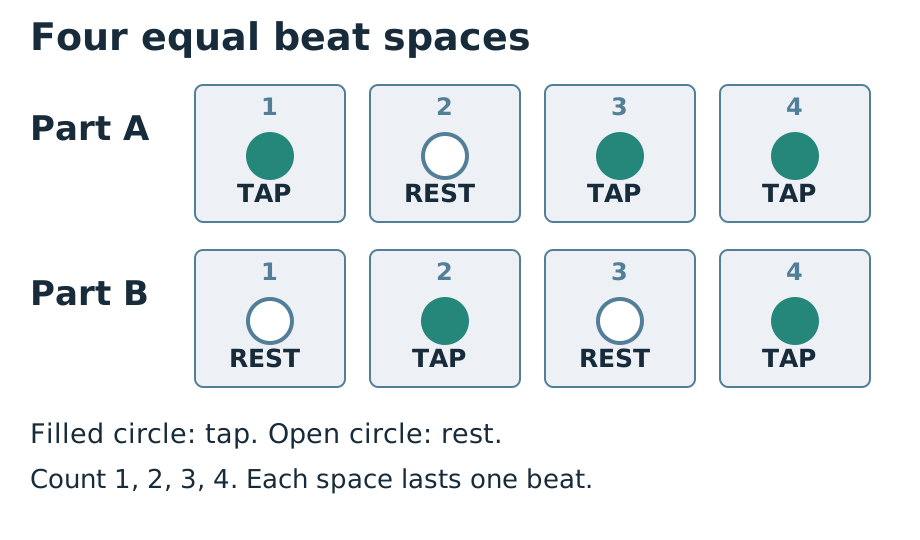
ART_GROW_A2_W02_P1 · Public · 1/14
Autumn 2 · Week 2 · Lesson 1 · Monday 9 November 2026
Recall and get ready
Show a soft tap, then stop on the cue.
Point across four beat boxes at an even pace.
What could you do during a silent beat?
Choose a comfortable way to join today.
Staff check after responding
Soft action stops on the agreed visual cue; teach the cue if it is new.
Four equally spaced points; avoid rushing the final box.
Keep a small silent movement, point or count in the mind. A rest still has length.
Accept quiet tap, silent point, sign or directing a partner; check the pupil retains the musical choice.
In your book: Show four even beats and your comfortable action.
Type instead
Use your usual way to keep a copy of any typed work.
Staff feedback loop · Arrival
- Voice
- Allow the pupil to point, speak, sign, draw or write. Read any scribed words back.
- Audience
- Listen and check the pupil agrees with the record.
- Next step
- Give one specific success and one next step. Allow another try in the same colour, on the same page or usual mode.
- Responded
- Use R only after Voice and Audience, a next step, and the pupil response. Record the actual support used.
ART_GROW_A2_W02_P1 · Public · 2/14
Autumn 2 · Week 2 · Lesson 1 · Monday 9 November 2026
Look, hear and choose
Which part has one rest: A or B?
Staff check after responding
A has one rest, on beat 2. B has two rests, on beats 1 and 3. In both parts every silent beat lasts as long as a tapped beat. Point through all four boxes to check.
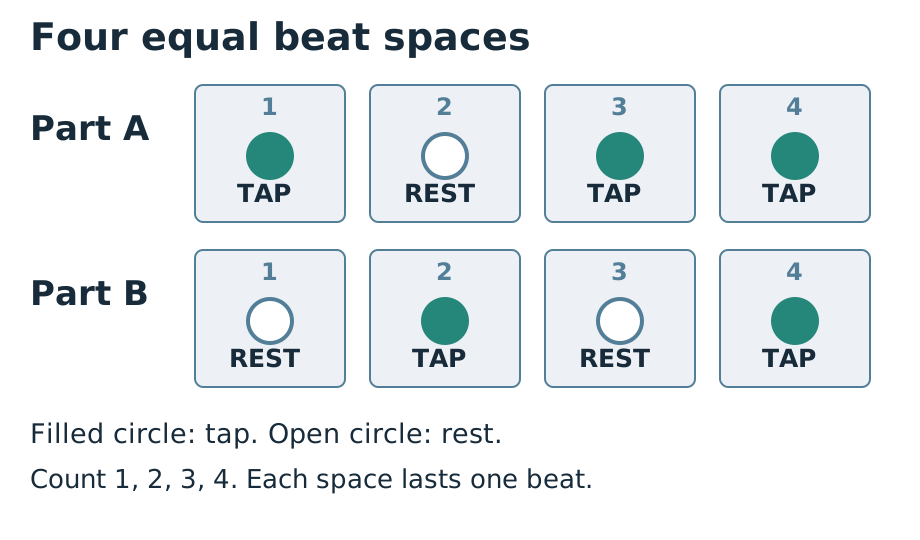
In your book: A or B, with a rest count from the score.
Type instead
Use your usual way to keep a copy of any typed work.
Staff feedback loop · Starter
- Voice
- Allow the pupil to point, speak, sign, draw or write. Read any scribed words back.
- Audience
- Listen and check the pupil agrees with the record.
- Next step
- Give one specific success and one next step. Allow another try in the same colour, on the same page or usual mode.
- Responded
- Use R only after Voice and Audience, a next step, and the pupil response. Record the actual support used.
ART_GROW_A2_W02_P1 · Public · 3/14
Autumn 2 · Week 2 · Lesson 1 · Monday 9 November 2026
Read and count
Point to four boxes. Read TAP, REST, TAP, TAP.
Wait for 1, 2, 3, 4. Start on the next 1.
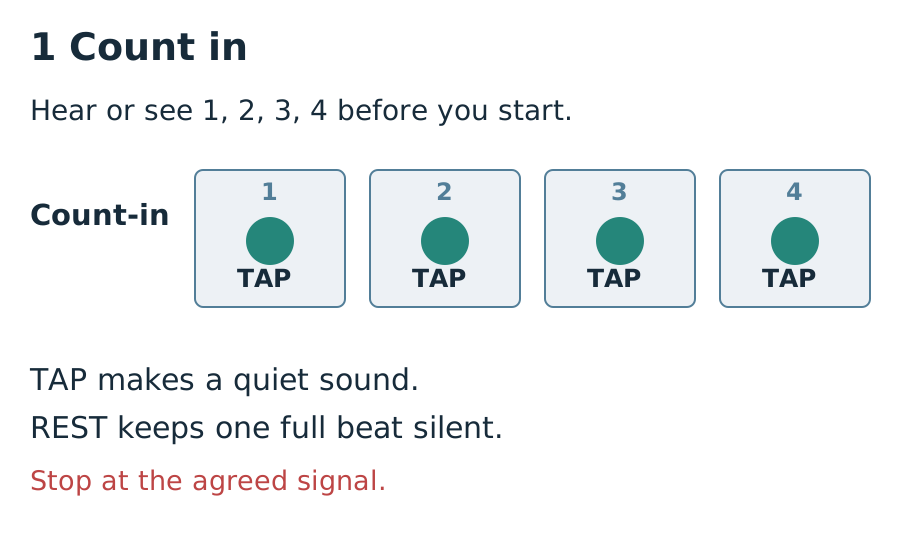
In your book: Copy or sketch part A with four numbered boxes.
Type instead
Use your usual way to keep a copy of any typed work.
Staff feedback loop · I do
- Voice
- Allow the pupil to point, speak, sign, draw or write. Read any scribed words back.
- Audience
- Listen and check the pupil agrees with the record.
- Next step
- Give one specific success and one next step. Allow another try in the same colour, on the same page or usual mode.
- Responded
- Use R only after Voice and Audience, a next step, and the pupil response. Record the actual support used.
ART_GROW_A2_W02_P1 · Public · 4/14
Autumn 2 · Week 2 · Lesson 1 · Monday 9 November 2026
Play and check
Play part A twice. Give each box one full beat.
Hear one useful comment. Choose a next step and try again.
In your book: Show where you wait, start and rest.
Type instead
Use your usual way to keep a copy of any typed work.
Staff feedback loop · I do
- Voice
- Allow the pupil to point, speak, sign, draw or write. Read any scribed words back.
- Audience
- Listen and check the pupil agrees with the record.
- Next step
- Give one specific success and one next step. Allow another try in the same colour, on the same page or usual mode.
- Responded
- Use R only after Voice and Audience, a next step, and the pupil response. Record the actual support used.
ART_GROW_A2_W02_P1 · Public · 5/14
Autumn 2 · Week 2 · Lesson 1 · Monday 9 November 2026
Words for our part
pulse — Even beats that keep the music moving.
part — The pattern one player or group follows.
rest — One beat with no sound. Keep counting.
count-in — A count before we start together.
In your book: Use one word in a sentence or sketch.
Type instead
Use your usual way to keep a copy of any typed work.
Staff feedback loop · I do
- Voice
- Allow the pupil to point, speak, sign, draw or write. Read any scribed words back.
- Audience
- Listen and check the pupil agrees with the record.
- Next step
- Give one specific success and one next step. Allow another try in the same colour, on the same page or usual mode.
- Responded
- Use R only after Voice and Audience, a next step, and the pupil response. Record the actual support used.
ART_GROW_A2_W02_P1 · Public · 6/14
Autumn 2 · Week 2 · Lesson 1 · Monday 9 November 2026
Play with the count-in
Count in together: 1, 2, 3, 4. Wait until the next 1.
Point and play part A twice: TAP REST TAP TAP.
In your book: A checked count-in and two attempts of part A.
Type instead
Use your usual way to keep a copy of any typed work.
Staff feedback loop · We do
- Voice
- Allow the pupil to point, speak, sign, draw or write. Read any scribed words back.
- Audience
- Listen and check the pupil agrees with the record.
- Next step
- Give one specific success and one next step. Allow another try in the same colour, on the same page or usual mode.
- Responded
- Use R only after Voice and Audience, a next step, and the pupil response. Record the actual support used.
ART_GROW_A2_W02_P1 · Public · 7/14
Autumn 2 · Week 2 · Lesson 1 · Monday 9 November 2026
Check, respond and retry
The listener checks beat 2 stays silent for a full beat.
Choose one next step, then repeat once with less adult pointing.
Staff check after responding
Start after the count-in. Taps occur on 1, 3 and 4; beat 2 is silent for the same length. The next cycle begins one beat after beat 4. Accept a steady silent performance with accurate pointing.
In your book: Your rest check and one response to feedback.
Type instead
Use your usual way to keep a copy of any typed work.
Staff feedback loop · We do
- Voice
- Allow the pupil to point, speak, sign, draw or write. Read any scribed words back.
- Audience
- Listen and check the pupil agrees with the record.
- Next step
- Give one specific success and one next step. Allow another try in the same colour, on the same page or usual mode.
- Responded
- Use R only after Voice and Audience, a next step, and the pupil response. Record the actual support used.
ART_GROW_A2_W02_P1 · Public · 8/14
Autumn 2 · Week 2 · Lesson 1 · Monday 9 November 2026
Choose one route
Supported: use the score with help.
Independent: keep your own part.
Aspire: add repeats, comparison or a cue.
Use one route. Keep your own record.
In your book: Your selected part and practice method.
Type instead
Use your usual way to keep a copy of any typed work.
Staff feedback loop · You do
- Voice
- Allow the pupil to point, speak, sign, draw or write. Read any scribed words back.
- Audience
- Listen and check the pupil agrees with the record.
- Next step
- Give one specific success and one next step. Allow another try in the same colour, on the same page or usual mode.
- Responded
- Use R only after Voice and Audience, a next step, and the pupil response. Record the actual support used.
ART_GROW_A2_W02_P1 · Public · 9/14
Autumn 2 · Week 2 · Lesson 1 · Monday 9 November 2026
Supported
Read A: TAP REST TAP TAP.
Count in with an adult and follow the beat numbers.
Tap or point twice. Keep the rest for one beat.
Show one thing that stayed in time.
Respond to one next step and try again.
In your book: One supported attempt and your response.
Type instead
Use your usual way to keep a copy of any typed work.
Staff feedback loop · You do
- Voice
- Allow the pupil to point, speak, sign, draw or write. Read any scribed words back.
- Audience
- Listen and check the pupil agrees with the record.
- Next step
- Give one specific success and one next step. Allow another try in the same colour, on the same page or usual mode.
- Responded
- Use R only after Voice and Audience, a next step, and the pupil response. Record the actual support used.
ART_GROW_A2_W02_P1 · Public · 10/14
Autumn 2 · Week 2 · Lesson 1 · Monday 9 November 2026
Independent
Mark the rest in A: TAP REST TAP TAP.
Start on the next 1 after the count-in.
Play twice while a partner points silently.
Ask for a rest and repeat check.
Respond and replay with less help.
In your book: Two repeats and a listener check.
Type instead
Use your usual way to keep a copy of any typed work.
Staff feedback loop · You do
- Voice
- Allow the pupil to point, speak, sign, draw or write. Read any scribed words back.
- Audience
- Listen and check the pupil agrees with the record.
- Next step
- Give one specific success and one next step. Allow another try in the same colour, on the same page or usual mode.
- Responded
- Use R only after Voice and Audience, a next step, and the pupil response. Record the actual support used.
ART_GROW_A2_W02_P1 · Public · 11/14
Autumn 2 · Week 2 · Lesson 1 · Monday 9 November 2026
Aspire
Read A, then B: REST TAP REST TAP.
Compare their taps and rests.
Play either part four times with a silent count-in.
Ask a listener to check your pulse.
Change your practice method and explain its effect.
In your book: Your comparison or longer repeat check.
Type instead
Use your usual way to keep a copy of any typed work.
Staff feedback loop · You do
- Voice
- Allow the pupil to point, speak, sign, draw or write. Read any scribed words back.
- Audience
- Listen and check the pupil agrees with the record.
- Next step
- Give one specific success and one next step. Allow another try in the same colour, on the same page or usual mode.
- Responded
- Use R only after Voice and Audience, a next step, and the pupil response. Record the actual support used.
ART_GROW_A2_W02_P1 · Public · 12/14
Autumn 2 · Week 2 · Lesson 1 · Monday 9 November 2026
My real practice record
My part is ___.
I kept the pulse by ___.
The listener noticed ___.
My next step was ___. On my next try ___.
Keep my real practice note in the arts log.
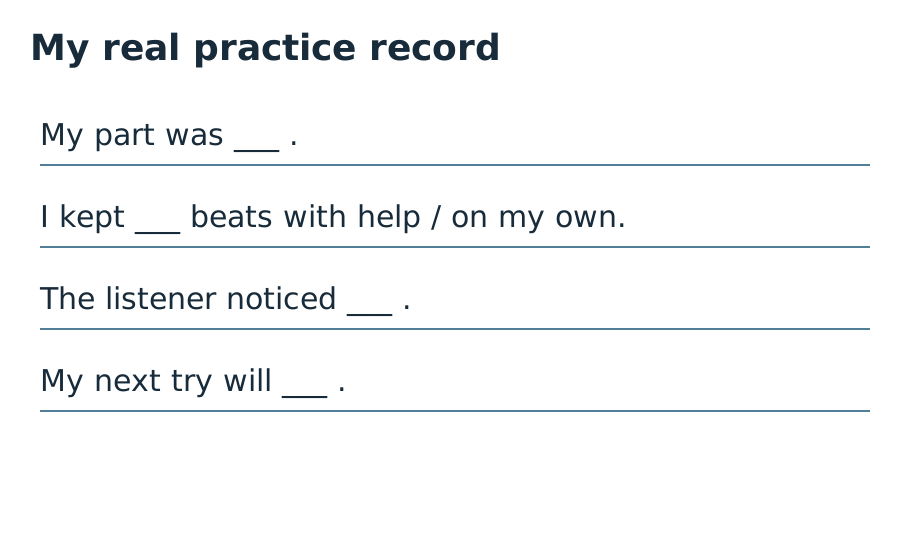
In your book: Your own practice note and next attempt.
Type instead
Use your usual way to keep a copy of any typed work.
Staff feedback loop · Review
- Voice
- Allow the pupil to point, speak, sign, draw or write. Read any scribed words back.
- Audience
- Listen and check the pupil agrees with the record.
- Next step
- Give one specific success and one next step. Allow another try in the same colour, on the same page or usual mode.
- Responded
- Use R only after Voice and Audience, a next step, and the pupil response. Record the actual support used.
ART_GROW_A2_W02_P1 · Public · 13/14
Autumn 2 · Week 2 · Lesson 1 · Monday 9 November 2026
What helped your part?
Where is the rest in part A?
When do you start after the count-in?
What did you change or keep after the comment?
Staff check after responding
Beat 2. It takes one full beat.
On the next beat 1 after the count-in finishes.
A specific actual response, such as following the pointer through rest 2, plus a further attempt. Do not fill a response for the pupil.
In your book: The rest, start point and one useful next step.
Type instead
Use your usual way to keep a copy of any typed work.
Staff feedback loop · Exit
- Voice
- Allow the pupil to point, speak, sign, draw or write. Read any scribed words back.
- Audience
- Listen and check the pupil agrees with the record.
- Next step
- Give one specific success and one next step. Allow another try in the same colour, on the same page or usual mode.
- Responded
- Use R only after Voice and Audience, a next step, and the pupil response. Record the actual support used.
ART_GROW_A2_W02_P1 · Public · 14/14
Knowledge organiser · Autumn 2 · Week 2 · Lesson 1
I can learn a four-beat part and repeat it with a steady pulse.
I can follow the count-in and start on beat 1.
I can keep each rest as long as a tap.
I can repeat my part twice without speeding up.
pulse — Even beats that keep the music moving.
part — The pattern one player or group follows.
rest — One beat with no sound. Keep counting.
count-in — A count before we start together.
Picture colours: navy headings; blue outlines and beat numbers; teal TAP circles; white REST circles and paper; grey beat spaces; red STOP reminder. Logo: navy background, mint green ring, cream M, amber star, black corners. Words, numbers and shapes give the meaning.
Word help · Autumn 2 · Week 2 · Lesson 1
pulse — Even beats that keep the music moving.
part — The pattern one player or group follows.
rest — One beat with no sound. Keep counting.
count-in — A count before we start together.
My part is ___ on beats ___.
I kept the rest by ___.
The listener noticed ___.
Next I will ___, then try again.
Picture colours: navy headings; blue outlines and beat numbers; teal TAP circles; white REST circles and paper; grey beat spaces; red STOP reminder. Logo: navy background, mint green ring, cream M, amber star, black corners. Words, numbers and shapes give the meaning.
Tools & print · Autumn 2 · Week 2 · Lesson 1
Open the page you need. Use the print command in your usual way.
Pause · Autumn 2 · Week 2 · Lesson 1
Put down the sound maker. Rest your hands. Breathe slowly. Choose a quiet space if you need it.
When you feel ready, point to your place and join the next count-in.
Staff notes · Autumn 2 · Week 2 · Lesson 1
GROW uses Independent as the starting route. Offer Supported and optional Aspire without changing the weekly outcome. Use a pair and a trio for five learners; rotate player, pulse keeper and listener so every pupil learns a part and has a personal record. Agree a quiet stop cue. Model following one instruction at a time: look, wait, play, stop. Quiet finger taps, silent pointing or signs are valid access modes; offer a quiet space and a pause. Do not require solos or a public audience. Scribe exact words or confirmed choices, read them back and allow corrections. Plan in any language before sharing in the chosen mode. Give one precise success and one NS next step. The pupil responds in the same colour, on the same page or usual mode, then tries the part again. Record R only when Voice and Audience are present, one NS has been set and the pupil has responded. Use VF / WS / I / NS / // / ? / E / R accurately.
Set out part A with beat numbers 1–4 and a clear repeat boundary. Agree the low volume and the red STOP signal. Check each pupil can see the count-in and can choose a comfortable action. Arrange a pair and a trio with predictable turns. Keep personal code fields blank. The adult model stays labelled class example. No track, recording or named artist is needed.
During minutes 34–37, keep each pupil’s actual practice note with the chosen score, read back any scribed words, and return cards. Record support used and one next step. Collect no personal disclosure. Put selected evidence in the existing arts log; record the real date only after teaching.
Observe each pupil reading or showing a part, waiting for the count-in, keeping the rest and repeating. Note the actual support and pupil response to one next step. Keep a short pupil-authored practice record and a score or description. This supports practice within the award; it does not certify a whole part.
Scheme outcome: Learn a part for a group performance.
Demonstration
0–15 seconds: Point across the four numbered boxes of part A: TAP REST TAP TAP. Say each word at an even pace. Explain that the four beats repeat as one short part.
15–30 seconds: Show the blue COUNT-IN card. Count 1, 2, 3, 4 at a calm even pace while the other hand waits. Say: “I start on the next 1, after the count-in.”
30–45 seconds: Play two cycles: TAP REST TAP TAP | TAP REST TAP TAP. Keep a small silent movement on every rest. Point to beat 1 at the repeat. Do not compress the silence.
45–60 seconds: Ask the listener which rest stayed in time. Model: “My rest was short. I will point to box 2 for a full beat.” Play one more cycle and show how the comment changed the next attempt.
Misconceptions and corrections
A rest is skipped and the next tap arrives early: Keep all four beat positions visible. Count 1–2–3–4 evenly while silently moving on beat 2. Replay slowly, then fade the adult count.
The pupil starts during the count-in: Use WAIT then START. Rehearse the count-in without playing; move the pointer to beat 1 only after the fourth count.
Repeating means going faster: Show the boundary after beat 4. Keep the next beat 1 the same distance away. Use eight steady silent pulses and let the pupil add the part.
Prompt ladder
Point to the relevant place or instruction.
Ask one short question.
Rephrase the instruction.
Provide a scaffold or a choice.
Model the first step only, then return the task.
Cfu
{"question": "Part A is TAP REST TAP TAP. What happens on beat 2, and how long does it last?", "answer": "No sound for one full beat; point or move silently while counting.", "decision": "If every pupil can show this, fade spoken counting. If anyone compresses the rest, model one full silent beat, practise together, then check individually."}
Hinge
{"question": "Part A repeats. After beat 4, which action comes on the next equal beat? A: TAP on the new 1. B: Wait an extra beat. C: Start faster.", "answer": "A: TAP on the new 1. The repeat has the same pulse.", "decision": "All choose at once. If all identify A and demonstrate the boundary, move to independent work. Otherwise count eight equal beats with pointing, add the score, then check the parallel question."}
Parallel hinge
{"question": "Part C is TAP TAP REST TAP. After its beat 4, what comes next when C repeats?", "answer": "TAP on the next beat 1, at the same pace. The rest remains on beat 3.", "decision": "Ask each pupil to show the boundary. Keep the visible pulse support for anyone who needs it; log the actual help."}
Teacher support
{"cognition": "Teach one four-beat chunk. Model, practise together, then fade voice and pointing while keeping the score visible.", "communication": "Pair words with TAP, REST, WAIT and STOP symbols. Allow processing time, signs, pointing and checked scribing.", "semh": "Agree turns and a quiet stop cue. Offer a trusted partner, silent role, pause and return. No forced solo.", "sensory": "Use soft taps or silent directing from a stable position. Avoid painful actions or loud objects. Offer a quiet space.", "eal": "Model terms with actions. Plan in any language. Check meaning through a demonstration or confirmed choice.", "Five-a-day": "Explicit model; count-check-retry strategy; numbered-box scaffold; flexible pair/trio; static visual teaching aid."}
Ta focus
{"I do": "Track eyes or pointer across all four boxes. Check access and stop cue.", "We do": "Observe whether rest 2 takes a full beat; point without playing over the pupil.", "Independent": "Record one individual attempt and actual prompt. Return the next action to the pupil after support."}
Formative
Give one precise success and one NS next step. The pupil responds in the same colour, on the same page or usual mode, then tries the part again. Record R only when Voice and Audience are present, one NS has been set and the pupil has responded. Use VF / WS / I / NS / // / ? / E / R accurately.