
Autumn 2 · Week 2 · Lesson 1 · Monday 9 November 2026
Keep four even beats
I can keep a steady beat and leave a quiet rest.
I can leave the same gap from beat to beat.
I can keep a rest quiet for one whole beat.
I can start and stop with a cue.
You can tap, point, sign, nod or use a quiet hand move. Ask for less sound or a pause. Use your usual way to show what you know.
Knowledge organiser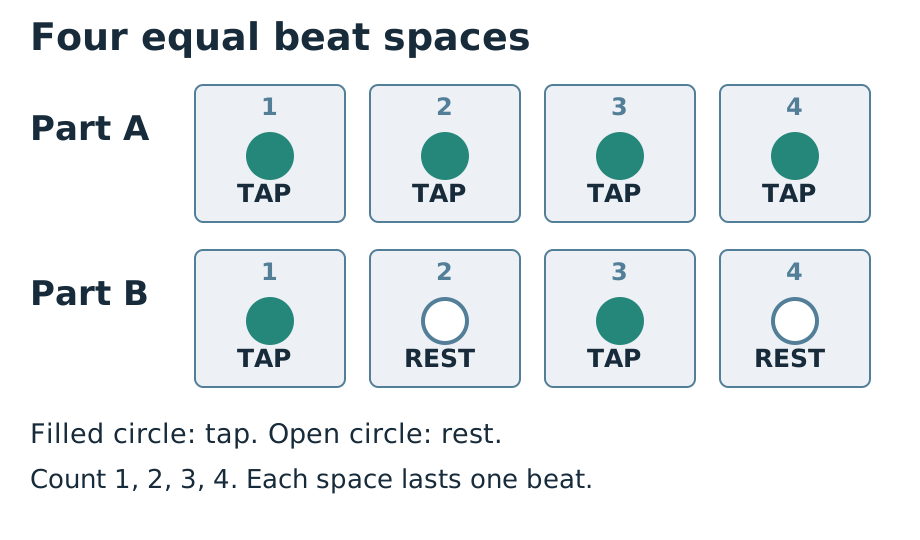
ART_BUILD_A2_W02_P1 · Public · 1/14
Autumn 2 · Week 2 · Lesson 1 · Monday 9 November 2026
Get ready for the beat
Choose a quiet way to tap or show a beat.
Point to the four numbered spaces.
Show the STOP cue.
Tap four slow, even taps with help.
Staff check after responding
Finger tap, nod, pointer or another comfortable timed movement. No sound is required.
The pupil identifies all four positions in order.
A raised flat hand or the agreed printed STOP cue. Check pupils can see it.
Four movements with roughly equal time gaps. A missed attempt is diagnostic; model again without judgement.
In your book: Four beat spaces, numbered 1 to 4.
Type instead
Use your usual way to keep a copy of any typed work.
Staff feedback loop · Arrival
- Voice
- Allow the pupil to point, speak, sign, draw or write. Read any scribed words back.
- Audience
- Listen and check the pupil agrees with the record.
- Next step
- Give one specific success and one next step. Allow another try in the same colour, on the same page or usual mode.
- Responded
- Use R only after Voice and Audience, a next step, and the pupil response. Record the actual support used.
ART_BUILD_A2_W02_P1 · Public · 2/14
Autumn 2 · Week 2 · Lesson 1 · Monday 9 November 2026
Look, listen and choose
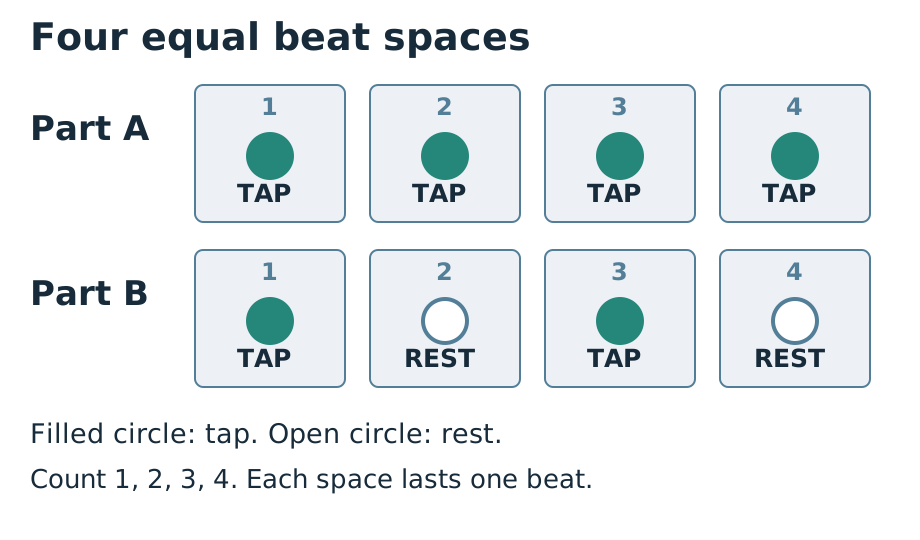
Which part has a quiet rest: A or B?
Staff check after responding
B. Beats two and four are full quiet rests. A and B both keep the same four even beat spaces. Do not treat B as unsteady because it has fewer sounds.
In your book: A or B, with one reason.
Type instead
Use your usual way to keep a copy of any typed work.
Staff feedback loop · Starter
- Voice
- Allow the pupil to point, speak, sign, draw or write. Read any scribed words back.
- Audience
- Listen and check the pupil agrees with the record.
- Next step
- Give one specific success and one next step. Allow another try in the same colour, on the same page or usual mode.
- Responded
- Use R only after Voice and Audience, a next step, and the pupil response. Record the actual support used.
ART_BUILD_A2_W02_P1 · Public · 3/14
Autumn 2 · Week 2 · Lesson 1 · Monday 9 November 2026
Watch and Tap
Watch the count-in: one, two, three, four.
Tap once in each numbered space. Keep it even.
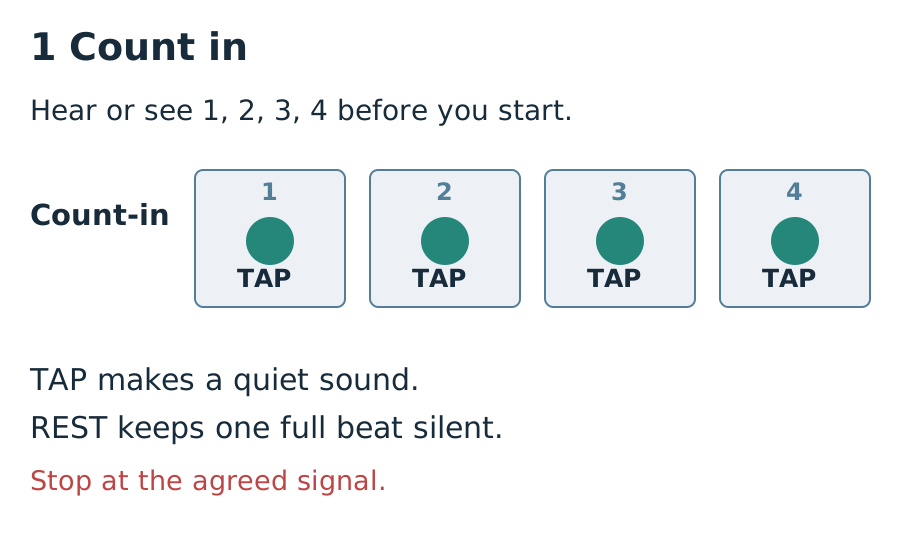
In your book: The count-in you watched.
Type instead
Use your usual way to keep a copy of any typed work.
Staff feedback loop · I do
- Voice
- Allow the pupil to point, speak, sign, draw or write. Read any scribed words back.
- Audience
- Listen and check the pupil agrees with the record.
- Next step
- Give one specific success and one next step. Allow another try in the same colour, on the same page or usual mode.
- Responded
- Use R only after Voice and Audience, a next step, and the pupil response. Record the actual support used.
ART_BUILD_A2_W02_P1 · Public · 4/14
Autumn 2 · Week 2 · Lesson 1 · Monday 9 November 2026
Rest and Check
At REST, stay quiet for one whole beat.
Try it again. Are the gaps still the same?
In your book: A mark for one full quiet rest.
Type instead
Use your usual way to keep a copy of any typed work.
Staff feedback loop · I do
- Voice
- Allow the pupil to point, speak, sign, draw or write. Read any scribed words back.
- Audience
- Listen and check the pupil agrees with the record.
- Next step
- Give one specific success and one next step. Allow another try in the same colour, on the same page or usual mode.
- Responded
- Use R only after Voice and Audience, a next step, and the pupil response. Record the actual support used.
ART_BUILD_A2_W02_P1 · Public · 5/14
Autumn 2 · Week 2 · Lesson 1 · Monday 9 November 2026
Words to use
beat — The even pulse you can tap or show.
steady — The beat keeps the same speed.
rest — A quiet beat. Keep its space in time.
count-in — A count that tells us when to start.
In your book: One word with an action or sketch.
Type instead
Use your usual way to keep a copy of any typed work.
Staff feedback loop · I do
- Voice
- Allow the pupil to point, speak, sign, draw or write. Read any scribed words back.
- Audience
- Listen and check the pupil agrees with the record.
- Next step
- Give one specific success and one next step. Allow another try in the same colour, on the same page or usual mode.
- Responded
- Use R only after Voice and Audience, a next step, and the pupil response. Record the actual support used.
ART_BUILD_A2_W02_P1 · Public · 6/14
Autumn 2 · Week 2 · Lesson 1 · Monday 9 November 2026
Try it together
We watch a count-in of four.
We play four even taps together.
In your book: A: four even taps.
Type instead
Use your usual way to keep a copy of any typed work.
Staff feedback loop · We do
- Voice
- Allow the pupil to point, speak, sign, draw or write. Read any scribed words back.
- Audience
- Listen and check the pupil agrees with the record.
- Next step
- Give one specific success and one next step. Allow another try in the same colour, on the same page or usual mode.
- Responded
- Use R only after Voice and Audience, a next step, and the pupil response. Record the actual support used.
ART_BUILD_A2_W02_P1 · Public · 7/14
Autumn 2 · Week 2 · Lesson 1 · Monday 9 November 2026
Keep the quiet beats
We play TAP REST TAP REST.
We keep a quiet beat at each rest.
Staff check after responding
All four beat positions continue at the same pace. In B, sounds occur on 1 and 3; 2 and 4 are silent full beats. Use a visible pointer or nod to show the pulse. Do not count the two sounds as two beats.
In your book: B: taps on 1 and 3, rests on 2 and 4.
Type instead
Use your usual way to keep a copy of any typed work.
Staff feedback loop · We do
- Voice
- Allow the pupil to point, speak, sign, draw or write. Read any scribed words back.
- Audience
- Listen and check the pupil agrees with the record.
- Next step
- Give one specific success and one next step. Allow another try in the same colour, on the same page or usual mode.
- Responded
- Use R only after Voice and Audience, a next step, and the pupil response. Record the actual support used.
ART_BUILD_A2_W02_P1 · Public · 8/14
Autumn 2 · Week 2 · Lesson 1 · Monday 9 November 2026
Choose one route
Supported: use the steps with help.
Independent: keep your own part.
Aspire: lead, then try a new part.
Use one route. Keep your own record.
In your book: Your chosen route and part.
Type instead
Use your usual way to keep a copy of any typed work.
Staff feedback loop · You do
- Voice
- Allow the pupil to point, speak, sign, draw or write. Read any scribed words back.
- Audience
- Listen and check the pupil agrees with the record.
- Next step
- Give one specific success and one next step. Allow another try in the same colour, on the same page or usual mode.
- Responded
- Use R only after Voice and Audience, a next step, and the pupil response. Record the actual support used.
ART_BUILD_A2_W02_P1 · Public · 9/14
Autumn 2 · Week 2 · Lesson 1 · Monday 9 November 2026
Supported
Use the four large spaces with help.
Watch a count-in of four.
Tap A once with a partner.
Point through B. Keep each REST quiet.
Try B once more. Show one thing to keep.
In your book: Your own attempt and next step.
Type instead
Use your usual way to keep a copy of any typed work.
Staff feedback loop · You do
- Voice
- Allow the pupil to point, speak, sign, draw or write. Read any scribed words back.
- Audience
- Listen and check the pupil agrees with the record.
- Next step
- Give one specific success and one next step. Allow another try in the same colour, on the same page or usual mode.
- Responded
- Use R only after Voice and Audience, a next step, and the pupil response. Record the actual support used.
ART_BUILD_A2_W02_P1 · Public · 10/14
Autumn 2 · Week 2 · Lesson 1 · Monday 9 November 2026
Independent
Give a quiet count-in of four.
Tap A for four even beats.
Read B: TAP REST TAP REST.
Play B twice at the same pace.
Choose one next step. Try it again.
In your book: Your own attempt and next step.
Type instead
Use your usual way to keep a copy of any typed work.
Staff feedback loop · You do
- Voice
- Allow the pupil to point, speak, sign, draw or write. Read any scribed words back.
- Audience
- Listen and check the pupil agrees with the record.
- Next step
- Give one specific success and one next step. Allow another try in the same colour, on the same page or usual mode.
- Responded
- Use R only after Voice and Audience, a next step, and the pupil response. Record the actual support used.
ART_BUILD_A2_W02_P1 · Public · 11/14
Autumn 2 · Week 2 · Lesson 1 · Monday 9 November 2026
Aspire
Keep the same pulse for two rounds of B.
Give your partner a clear count-in.
Try B with a silent nod for every beat.
Tell how the nod helps with each rest.
Change one tap to a rest. Keep four spaces.
In your book: Your own attempt and next step.
Type instead
Use your usual way to keep a copy of any typed work.
Staff feedback loop · You do
- Voice
- Allow the pupil to point, speak, sign, draw or write. Read any scribed words back.
- Audience
- Listen and check the pupil agrees with the record.
- Next step
- Give one specific success and one next step. Allow another try in the same colour, on the same page or usual mode.
- Responded
- Use R only after Voice and Audience, a next step, and the pupil response. Record the actual support used.
ART_BUILD_A2_W02_P1 · Public · 12/14
Autumn 2 · Week 2 · Lesson 1 · Monday 9 November 2026
My real attempt
My quiet part was ___.
I kept the beat by ___.
At REST I ___.
Next I will ___.
Keep the real attempt at A page 1.
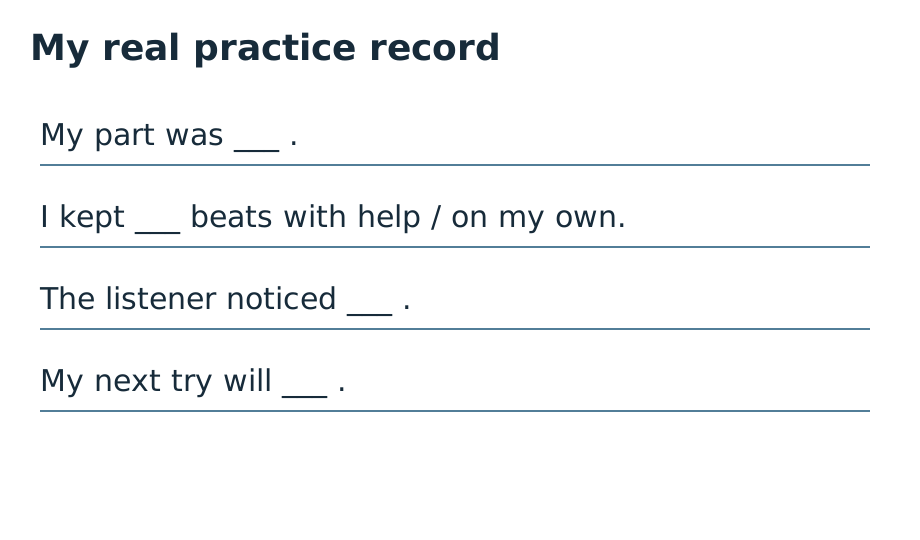
In your book: One success, one next step and your new try.
Type instead
Use your usual way to keep a copy of any typed work.
Staff feedback loop · You do
- Voice
- Allow the pupil to point, speak, sign, draw or write. Read any scribed words back.
- Audience
- Listen and check the pupil agrees with the record.
- Next step
- Give one specific success and one next step. Allow another try in the same colour, on the same page or usual mode.
- Responded
- Use R only after Voice and Audience, a next step, and the pupil response. Record the actual support used.
ART_BUILD_A2_W02_P1 · Public · 13/14
Autumn 2 · Week 2 · Lesson 1 · Monday 9 November 2026
What helped me keep time?
What is a steady beat?
What do you do at REST?
Show B once after the count-in.
Staff check after responding
An even pulse, with the same gap between beats. Accept a demonstration.
Stay quiet for one whole beat while the pulse continues.
After four even counts, tap on 1 and 3 and keep 2 and 4 quiet. Note the actual support and next step.
In your book: What you do to keep a quiet beat.
Type instead
Use your usual way to keep a copy of any typed work.
Staff feedback loop · Exit
- Voice
- Allow the pupil to point, speak, sign, draw or write. Read any scribed words back.
- Audience
- Listen and check the pupil agrees with the record.
- Next step
- Give one specific success and one next step. Allow another try in the same colour, on the same page or usual mode.
- Responded
- Use R only after Voice and Audience, a next step, and the pupil response. Record the actual support used.
ART_BUILD_A2_W02_P1 · Public · 14/14
Knowledge organiser · Autumn 2 · Week 2 · Lesson 1
I can keep a steady beat and leave a quiet rest.
I can leave the same gap from beat to beat.
I can keep a rest quiet for one whole beat.
I can start and stop with a cue.
beat — The even pulse you can tap or show.
steady — The beat keeps the same speed.
rest — A quiet beat. Keep its space in time.
count-in — A count that tells us when to start.
Picture colours: navy headings; blue outlines and beat numbers; teal TAP circles; white REST circles and paper; grey beat spaces; red STOP reminder. Logo: navy background, mint green ring, cream M, amber star, black corners. Words, numbers and shapes give the meaning.
Word help · Autumn 2 · Week 2 · Lesson 1
beat — The even pulse you can tap or show.
steady — The beat keeps the same speed.
rest — A quiet beat. Keep its space in time.
count-in — A count that tells us when to start.
I keep the beat by ___.
At REST I ___.
My taps were ___.
Next I will ___.
Picture colours: navy headings; blue outlines and beat numbers; teal TAP circles; white REST circles and paper; grey beat spaces; red STOP reminder. Logo: navy background, mint green ring, cream M, amber star, black corners. Words, numbers and shapes give the meaning.
Tools & print · Autumn 2 · Week 2 · Lesson 1
Open the page you need. Use the print command in your usual way.
Pause · Autumn 2 · Week 2 · Lesson 1
Put down the sound maker. Rest your hands. Breathe slowly. Choose a quiet space if you need it.
When you feel ready, point to your place and join the next count-in.
Staff notes · Autumn 2 · Week 2 · Lesson 1
Use Supported as needed, Independent for a pupil ready to take the lead, and Aspire for more depth. The route changes help, not the shared beat goal. Use five individual records within a pair and a trio; rotate beat keeper, part player and watcher. Never require solo performance. Quiet finger taps, a visible nod or pointing can show the same timing. Teach a raised flat hand as STOP; agree it before sound starts. Keep volume low and use a soft surface. Wait for each pupil to opt into a role and use a trusted partner when needed. Read back scribed words and let the pupil correct them. Give one clear success and one next step. A pupil responds in the same colour, on the same page or usual mode. Mark R only when Voice and Audience are present, one NS has been given and the pupil has made the response. Use VF, WS, I, NS, //, ?, E and R only for what happened. A photograph or class tick does not prove an individual skill. Pupil code and staff fields stay blank until actual use.
Place four numbered spaces where every pupil can see them. Check the soft tapping option and agree the flat-hand STOP cue. Keep the room quiet. Use a pair and a trio; rotate beat keeper, player and watcher. Give each pupil a strip and a personal response record. Model with original class parts only. Do not use commercial music or external media.
At 34 minutes, invite each pupil to try B once and choose one next step. Record the actual timing and prompt used. Ask the pupil to check the scribed comment. Return cards and mats; leave the next part strip ready for the second lesson. Put the selected pupil record at A page 1.
Week 2 builds steady pulse from the previous sound exploration. Use four beat positions and original class parts so the task is reproducible with quiet body percussion. Observe the pupil, not just the whole group. At A page 1 record the real method, prompt, one success and one next step. This is practice evidence for the award; do not prefill a part outcome or treat attendance as skill evidence.
Scheme outcome: Keep a steady beat / join a group piece.
Demonstration
0–15 seconds: Point to four numbered spaces. Give four slow, even counts without playing. Say: “This is the count-in. We start on the next one.”
15–30 seconds: Play A: TAP, TAP, TAP, TAP. Move the pointer through spaces 1–4 at the same rate. Say: “One tap in each space. My gaps stay the same.”
30–45 seconds: Play B: TAP, REST, TAP, REST. Keep the pointer moving through all four spaces. Say: “A rest is quiet. Beat two still takes one full space.”
45–60 seconds: Repeat B twice after a fresh four-count. Show the raised-hand stop cue. Say: “I keep the spaces even. I stop at the cue.” Let a pupil show beat two without a sound.
Misconceptions and corrections
The pupil speeds up after a rest: Keep the pointer moving through every numbered space. Say “tap, wait, tap, wait” at one pace. Practise B with a visible nod for every beat, then fade the nod.
The pupil skips a rest and starts the next tap early: Point to beat two and count its full length. Contrast TAP REST TAP REST with TAP TAP. Both rests need a place. Return to four even taps, then put the rests back.
A louder tap is treated as a better beat: Use soft taps or silent movements at the same pace. Praise timing, not loudness. Return to the agreed low sound level and stop cue.
Prompt ladder
Point to the place or instruction.
Ask one short question.
Say the instruction in a new way.
Give a choice or a small guide.
Show the first step only. Then give the task back.
Cfu
After I do, point to beat two in B. Ask: “Tap or quiet?” Each pupil shows quiet, then points to beat three on the next beat. If the pupil skips straight to three, repeat a slow model with a pointer.
Hinge
At We do 2, show B: TAP REST TAP REST. Ask: “Does beat two still take time?” Choose A: no time, or B: one full quiet beat. Correct B. If every pupil shows B and keeps one full quiet beat, move to route practice. If any pupil skips the rest, model four even spaces again and retest that pupil before independent playing.
Parallel hinge
Retest with REST TAP REST TAP. Ask: “What happens on beat one?” Correct: a full quiet beat; play on two. Check with a visible pointer rather than a verbal guess alone.
Teacher support
{"cognition": "Use four large numbered spaces. Show one step, repeat, then fade the pointer.", "communication": "Pair each word with a gesture. Accept sign, point or speech. Give wait time.", "semh": "Predictable start and stop; quiet sound; partner practice; pause and rejoin at a new count-in.", "sensory": "Soft finger tap, nod or pointer. Position the strip within sight and reach. Sound is optional.", "eal": "Plan in any language. Use the same word, symbol and action. Invite a short stem or demonstration.", "cold_call": {"F": "Point to REST. Show quiet.", "M": "Show where the next tap comes after beat two.", "H": "Explain why two taps can still take four beats. Invite a private or paired response first."}, "cfu": "After I do, point to beat two in B. Ask: “Tap or quiet?” Each pupil shows quiet, then points to beat three on the next beat. If the pupil skips straight to three, repeat a slow model with a pointer.", "hinge": "At We do 2, show B: TAP REST TAP REST. Ask: “Does beat two still take time?” Choose A: no time, or B: one full quiet beat. Correct B. If every pupil shows B and keeps one full quiet beat, move to route practice. If any pupil skips the rest, model four even spaces again and retest that pupil before independent playing.", "hinge_parallel": "Retest with REST TAP REST TAP. Ask: “What happens on beat one?” Correct: a full quiet beat; play on two. Check with a visible pointer rather than a verbal guess alone.", "hinge_decision": "All correct in choice and timed action: move on and fade one cue. Any error: remap four even spaces, model once, retest that pupil.", "ta_focus": {"I do": "Track who follows the pointer through the quiet beat. Prompt by pointing before speaking.", "We do": "Watch one pupil per round; note whether rests keep their full time. Fade the shared nod when ready.", "Independent": "Use the five-step ladder only as needed. Record the exact help and return the next step to the pupil."}}
Ta focus
{"I do": "Track who follows the pointer through the quiet beat. Prompt by pointing before speaking.", "We do": "Watch one pupil per round; note whether rests keep their full time. Fade the shared nod when ready.", "Independent": "Use the five-step ladder only as needed. Record the exact help and return the next step to the pupil."}