LAUNCH Science · W3L1 · lesson resources
Lens detective
Choose one shared task or resource within the current lesson stage. Keep the lesson’s 40-minute timetable and 15-minute independent work.
We Do · Lens detective
Choose the first safe step. Then predict what changes at higher power.
- Start at ×4 objective.
- Find and centre the specimen.
- Focus, then increase power.
Discuss, point, write or dictate your first reason. Use one example first; extend only if there is time.
Reveal shared reasoning after an attempt
With a ×10 eyepiece: ×4 gives ×40; ×40 gives ×400. The field of view shrinks. A larger image is not automatically clearer.
This page keeps your writing while it stays open. It does not save or send it.
Model explanation and diagram
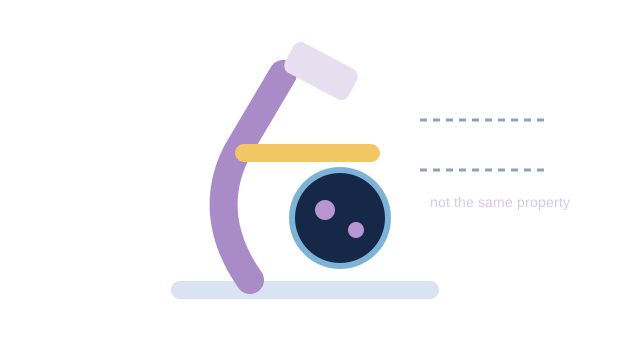
Magnification is how many times larger an image is. Resolution is whether close points can be seen separately. Enlarging a blur does not recover detail.
Watch for: Do not add the lens powers. At high power use fine focus only; follow the microscope’s approved procedure.
Give a smaller support cue
Total magnification = eyepiece × objective. A bigger image is not always a clearer image. Describe what you can see before you explain it.
Optional video · Microscopy
Watch for: What is the difference between making an image bigger and resolving more detail?
Use a short relevant extract within I Do, then pause for an explanation. The clip replaces part of the modelling time.
Open the freesciencelessons video in a new tab
No-video version · use the same question
Magnification compares image size with actual size. Resolution is the ability to distinguish two close points as separate. Increasing size alone does not reveal more detail.
Internet is needed for the optional clip. It is concept teaching; viewing it is not completion of a practical.