Test a phase-wheel model
Retrieve the lit-side rule
Where does moonlight come from?
What stays round while the Moon looks different?
Choose drawings, pre-cut circles or adult-operated kit.
Prepare your model safely
Use a ball, low-power torch and three drawn/card circles.
Keep the torch direction fixed; never shine it at eyes.
Keep room light, or choose the still-diagram route.
Check three positions
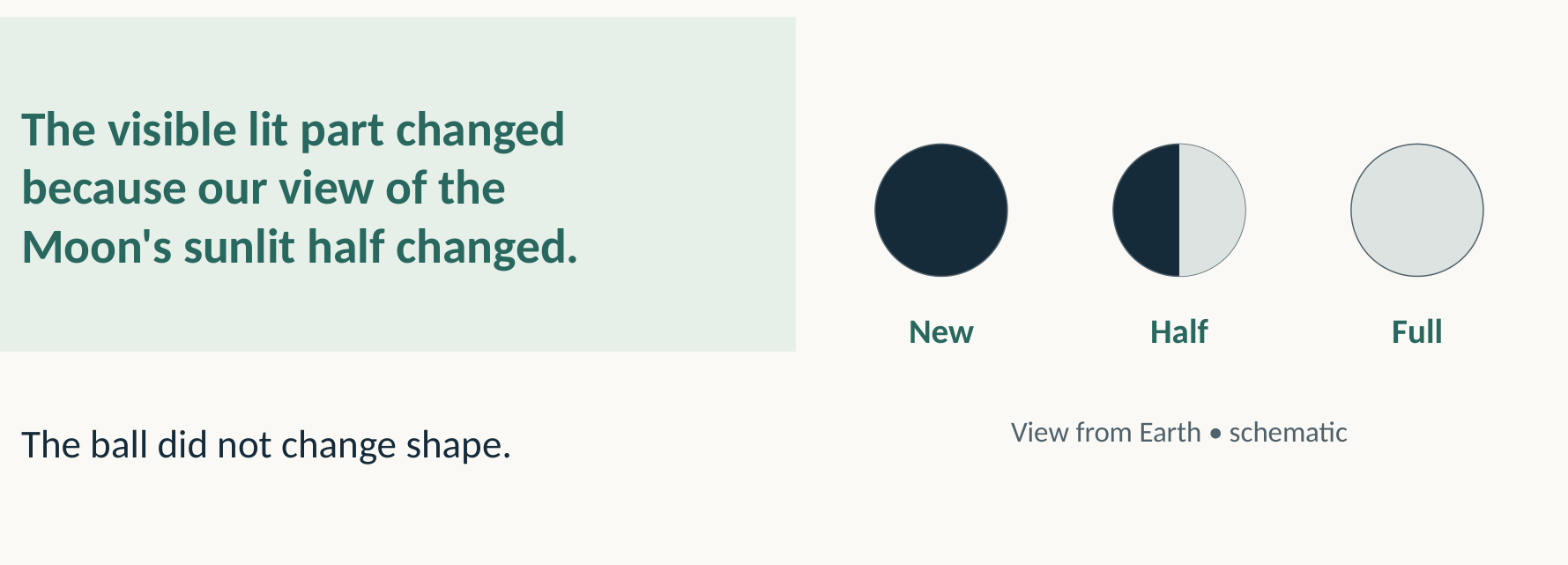
Near the light direction: check the new-Moon view.
To the side: check a half-Moon view.
Opposite the light: check the full-Moon view.
Make your three-view strip
Draw three equal circles or arrange pre-cut examples.
Shade the part not seen lit; label new, half and full.
Keep every circle the same round shape.
Explain what changed

Read the slide text
Pause for a shared check
Ask an adult or chosen partner to use the same viewpoint.
Check one view against its label.
Did the ball change shape, or the visible lit part?
Correct one label or view
Correct one phase label or shaded circle.
Explain what your model showed.
Add a model limit if this is your stretch route.
Reset the room and kit
Restore agreed room lighting.
Return ball, torch, cards and pencils.
Keep your labelled strip and explanation.
Say what helped or hindered
Did the model or still drawing help you understand?
Would a different light level, label or explanation help?
Point, sign, speak privately, or pass.
Check the agreed change
You asked for_____. We changed_____.
Did it help? What else needs explaining?
Exit: choose your explanation
Supported: does the Moon make its own visible light?
Standard: how long is one orbit around Earth?
Stretch: why are ordinary phases not Earth's shadow?
Check and keep one improvement
Moonlight is reflected sunlight.
One orbit is about 27.3 days; phase cycle about 29.5 days.
Ordinary phases come from our view of the sunlit half.
Use the controls or left and right arrow keys. Printing includes pupil content; model answers remain separate.