The Moon's journey
Same Moon. Changing view.
Explain how the Moon moves and why it looks different across a month.
Open image full sizeStart with what you think
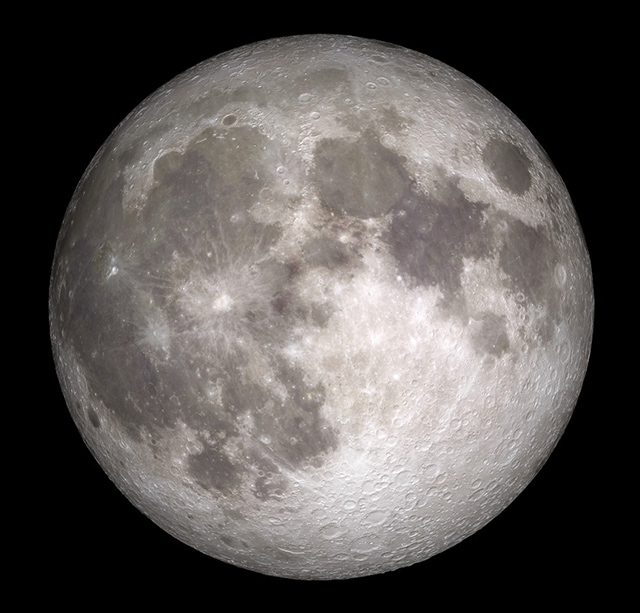
Supported: point to the full Moon on a phase strip.
Standard: estimate the time for one orbit of Earth.
Stretch: add where the Moon's light comes from.
Three things to work out
1 Orbit and time.
2 Where the light comes from.
3 Model the changing view.
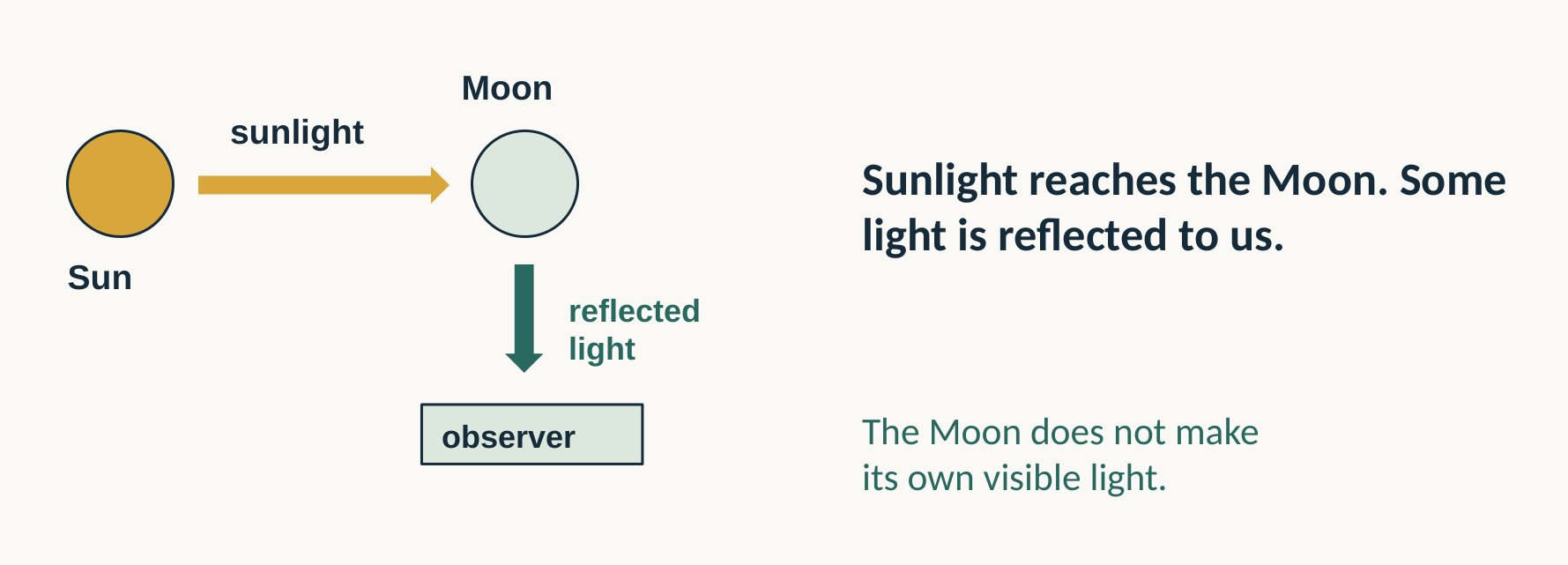
Moonlight begins at the Sun

Read the slide text
Keep the light direction fixed
Torch = Sun. Ball = Moon. Observer = a view from Earth.
Keep the light fixed while the ball changes position.
Watch the visible lit part. The ball stays round.
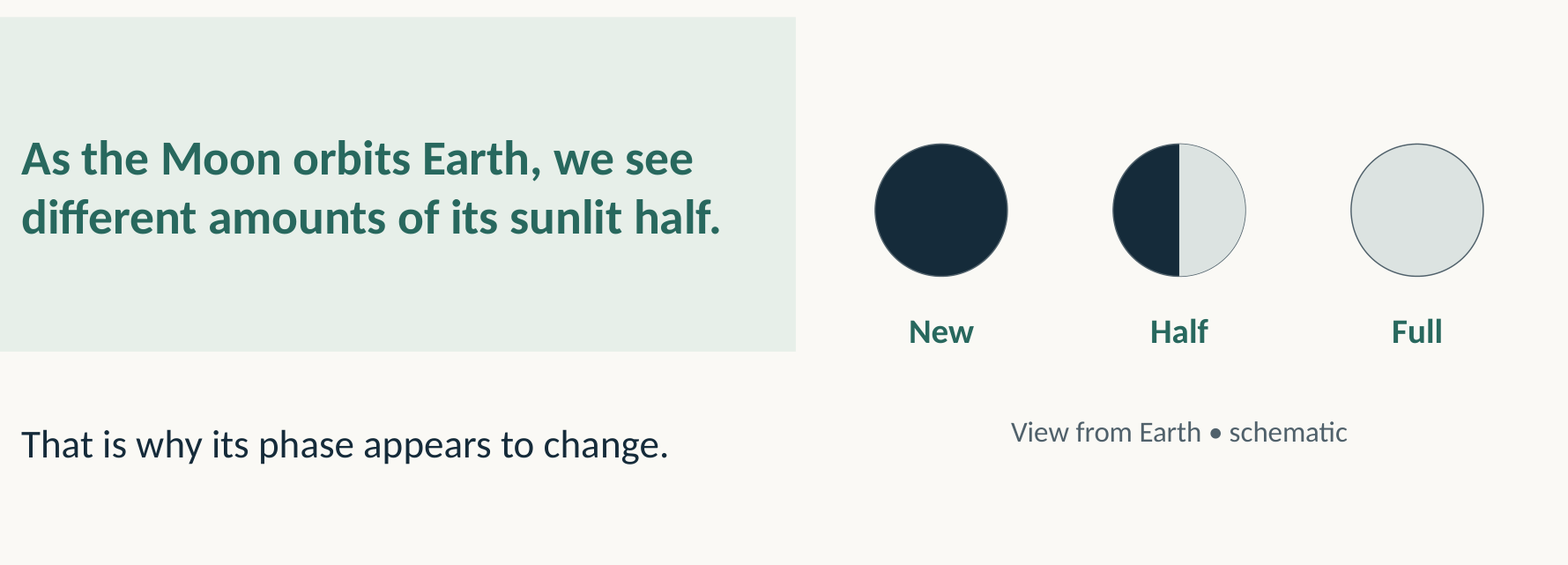
New, half and full: three views
| VIEW FROM EARTH | WHAT WE SEE LIT |
|---|---|
| New Moon Half Moon Full Moon | Little or none of the lit half About half the visible disc The whole visible disc |
What explains each observation?
An ordinary crescent Moon.
An ordinary full Moon.
New Moon is hard to see.
The Moon looks dark red during a lunar eclipse.
Phases and eclipses differ
| ORDINARY PHASES | LUNAR ECLIPSE |
|---|---|
| The viewing angle changes. The visible lit portion changes. The Moon remains round. | Earth blocks direct sunlight. Earth's shadow reaches the Moon. This is not the monthly phase cause. |
Explain cause, then observation

Read the slide text
Sort the five claims
The Moon reflects sunlight.
The Moon glows by itself.
Ordinary phases are caused by Earth's shadow.
The Moon orbits Earth in about a month.
The Moon is only visible at night.
Check the original claims
| TRUE | FALSE |
|---|---|
| The Moon reflects sunlight. One orbit is roughly a month. | It makes its own visible light. Earth's shadow causes phases. It is only visible at night. |
A complete model answer
The Moon reflects sunlight. As it orbits Earth, our view of the lit half changes.
Ordinary phases are not Earth's shadow.
Keep your explanation for Tuesday
Keep your claim-sort and corrected explanation.
Next lesson: test new, half and full views.
Choose one view to check again.
Use the controls or left and right arrow keys. Printing includes pupil content; model answers remain separate.