Run and judge a fair test
Plan. Repeat. Check. Conclude.
Use evidence to answer the question, and explain its limits.
Open image full sizeRecover the question and your plan

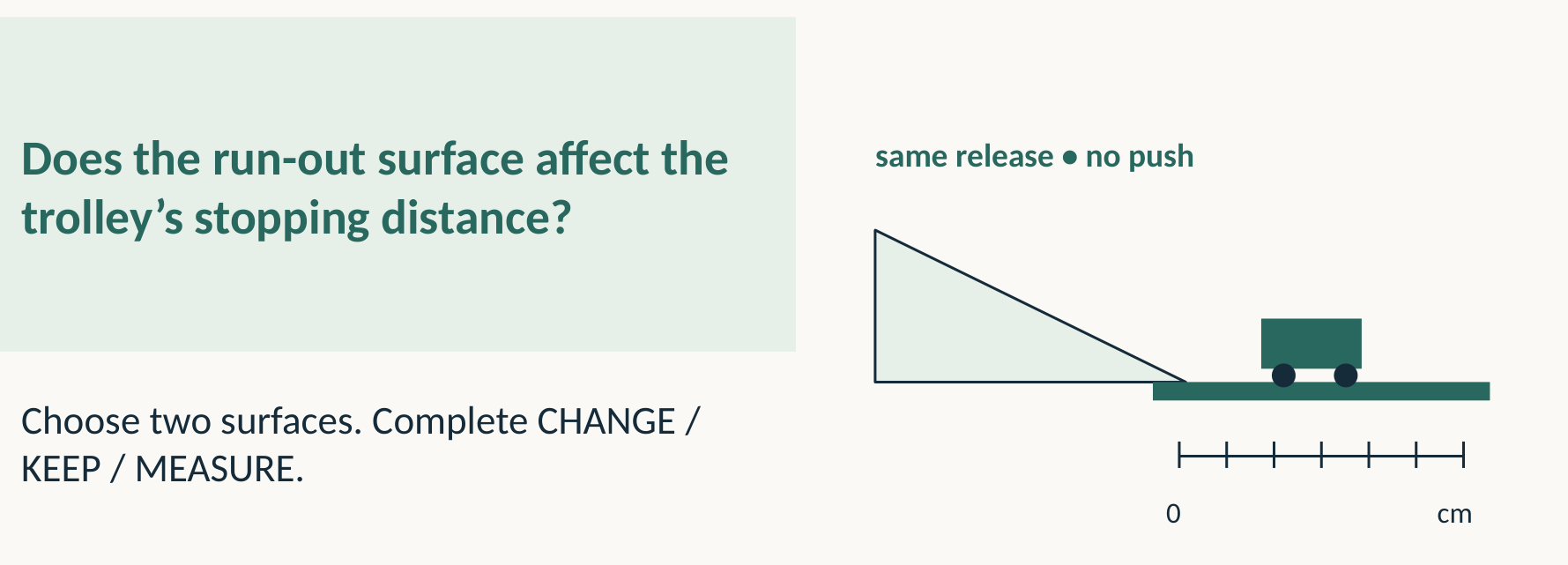
Read the slide text
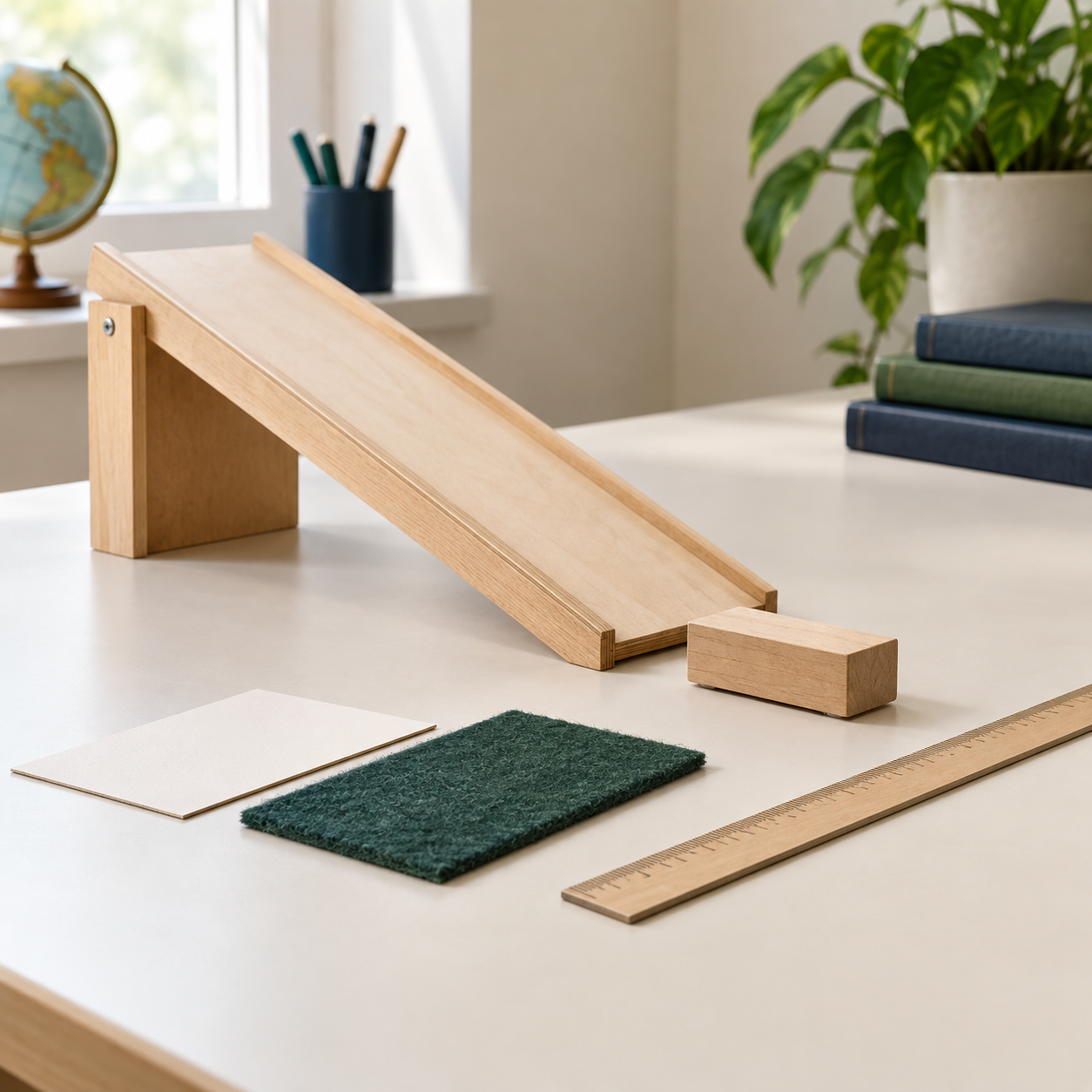
Check a safe, controlled setup
Adult secures a low ramp, clear run and padded stop.
Keep the trolley, ramp height and release mark fixed.
Keep the run-out level and the ramp join unchanged.
Agree the zero, trolley edge and no-push release.
Record in a useful table
Name each surface before testing.
Use columns: Trial 1 / cm, Trial 2 / cm, Trial 3 / cm.
Record from the same zero to the same trolley edge.
Keep notes about any method change or non-run.
Surface A: make three releases
Release without a push. Wait until the trolley stops.
Measure and record the first distance.
Reset to the same mark; repeat twice if practicable.
Keep every value and any method note.
Surface B: keep the controls
Change only the level run-out sample.
Recheck the ramp join, release and measuring zero.
Run three no-push trials if practicable.
Record distances in centimetres and note any issue.
Compare the repeated values
Are the three values for each surface close?
Is one run noticeably different? Keep it.
What did you observe about the method?
Use values from both surfaces in your explanation.
No kit? Interpret this model set
| INVENTED TEACHING DATA | WHAT MUST BE TRUE? |
|---|---|
| A: 48 cm, 50 cm, 49 cm B: 27 cm, 29 cm, 28 cm These are not your measurements. | Same trolley and ramp? Same no-push release and zero? Only run-out surface changed? |
Pause and inspect one uncertainty
Pause the kit. Compare the repeats.
Mark an unusual run or possible method issue.
Do not delete a result because it differs.
Decide whether one controlled retry would help.
Retry a method issue if time allows
Name the concern before repeating.
Correct it, then use the same planned method.
Label the retry separately from the original trial.
Optional: calculate a mean
Mean = total of the three distances ÷ 3
Model A: (48 + 50 + 49) ÷ 3 = 49 cm.
Answer using the evidence
Our evidence supports ___ because the distances were ___.
This applies to this setup. One limit or method concern is ___.
Keep the plan with the results
Keep your plan, all results and conclusion together.
Label actual, adult-recorded or model-data work.
Reset the space and return the equipment.
Your feedback has an audience
What helped while you waited between trials?
What could make testing or recording more accessible?
Point, sign, speak, write—or pass privately.
Adult: agree a change, explain limits and check back.
Explain why the method matters
Supported: how many variables did we plan to change?
Standard: name one control variable from this test.
Stretch: why are repeats more useful than one result?
Check and improve your answer
We changed the surface and controlled the release. Repeats helped us judge consistency.
An unexpected result stays in the record, with any method concern noted.
Use the controls or left and right arrow keys. Printing includes pupil content; model answers remain separate.