GROWScience
Lesson overviewGROW · Week 4

Levers, pulleys and gears

Change the force. Notice the trade-off.

Name mechanisms, find a pivot and explain a gain and a cost.

Contextual illustration of a wooden lever on a triangular pivot with a small block as its load. It is not a measured result.Open image full size
Levers, pulleys and gearsSlide 1 of 14
You Do · practiseGROW · Week 4

Find the turning point

Supported: point to where scissors turn.

Standard: name that turning point.

Stretch: find it on a wheelbarrow drawing too.

Look, point, describe or draw.

Levers, pulleys and gearsSlide 2 of 14
You Do · practiseGROW · Week 4

Check the wheelbarrow’s pivot

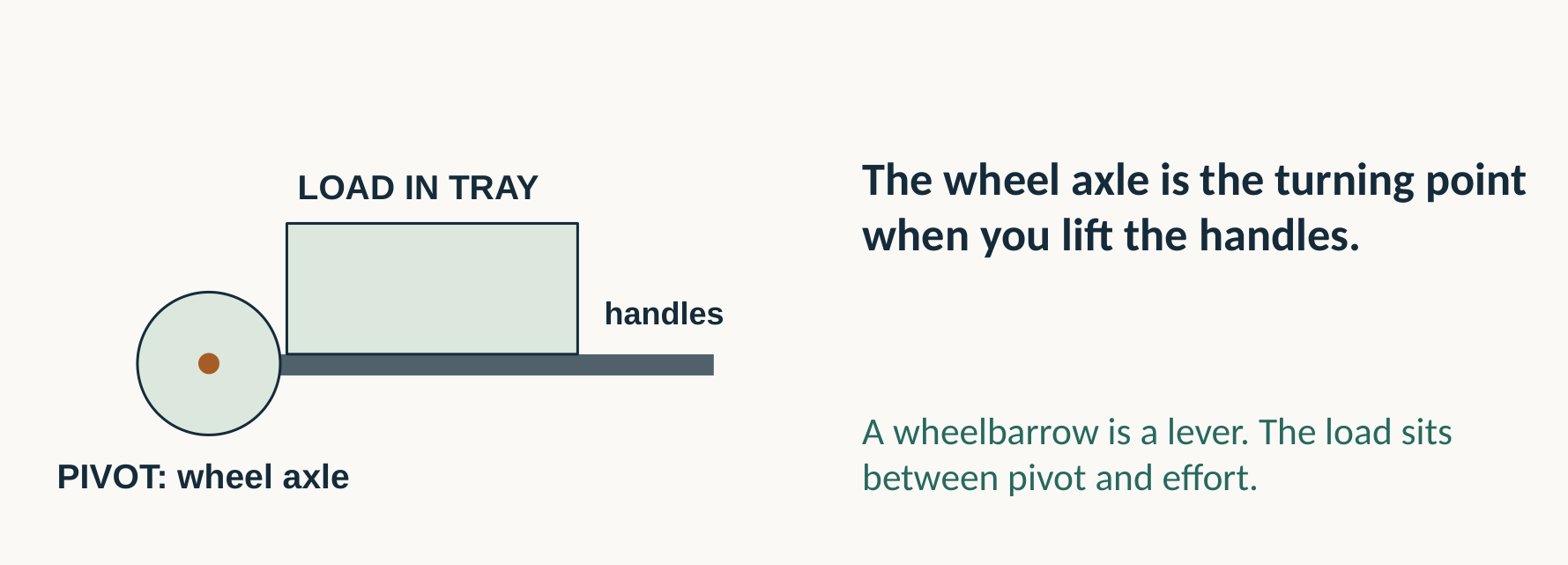
Wheelbarrow model: the wheel axle is the pivot at the left, the load sits in the tray in the middle, and the handles receive effort at the right.
Original teaching-pack diagram and labels.
Open image full size
Read the slide text
Wheelbarrow model: the wheel axle is the pivot at the left, the load sits in the tray in the middle, and the handles receive effort at the right. LOAD IN TRAY handles PIVOT: wheel axle The wheel axle is the turning point when you lift the handles. A wheelbarrow is a lever. The load sits between pivot and effort.
Levers, pulleys and gearsSlide 3 of 14
I Do · learn and modelGROW · Week 4

Three things to notice

1 Find the pivot.

2 Move it and compare the effort.

3 Explain what you gain and what it costs.

Levers, pulleys and gearsSlide 4 of 14
I Do · learn and modelGROW · Week 4

A lever turns about a pivot

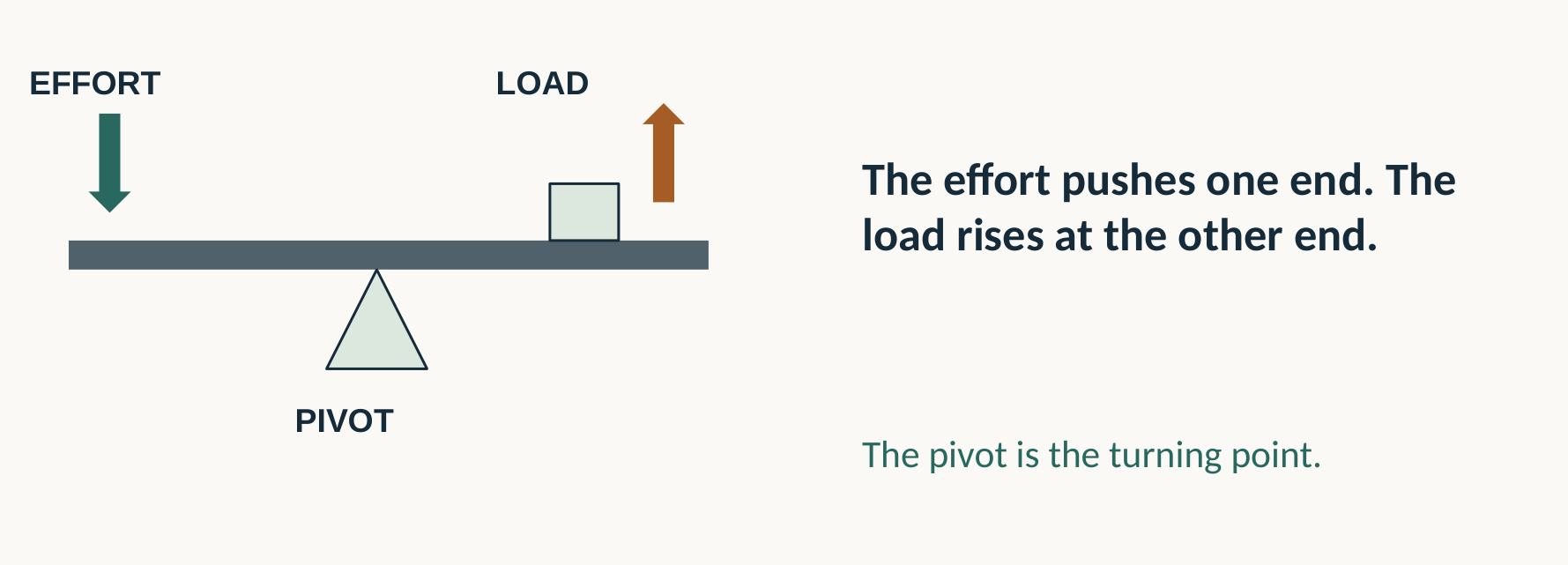
A lever rests on a central triangular pivot. A downward effort arrow at the left is paired with an upward load arrow at the right.
Original teaching-pack diagram and labels.
Open image full size
Read the slide text
A lever rests on a central triangular pivot. A downward effort arrow at the left is paired with an upward load arrow at the right. EFFORT LOAD PIVOT The effort pushes one end. The load rises at the other end. The pivot is the turning point.
Levers, pulleys and gearsSlide 5 of 14
I Do · learn and modelGROW · Week 4

Move the pivot, keep the load

Watch the adult use the middle pivot.

Predict what changes when it moves near the load.

Keep the effort point and small load rise the same.

Compare the effort and the hand’s travel.

Levers, pulleys and gearsSlide 6 of 14
We Do · think togetherGROW · Week 4

Which objects are levers?

Wheelbarrow

Scissors

Spanner on a bolt

Point to a turning point before naming it.

Levers, pulleys and gearsSlide 7 of 14
We Do · think togetherGROW · Week 4

A fixed pulley changes direction

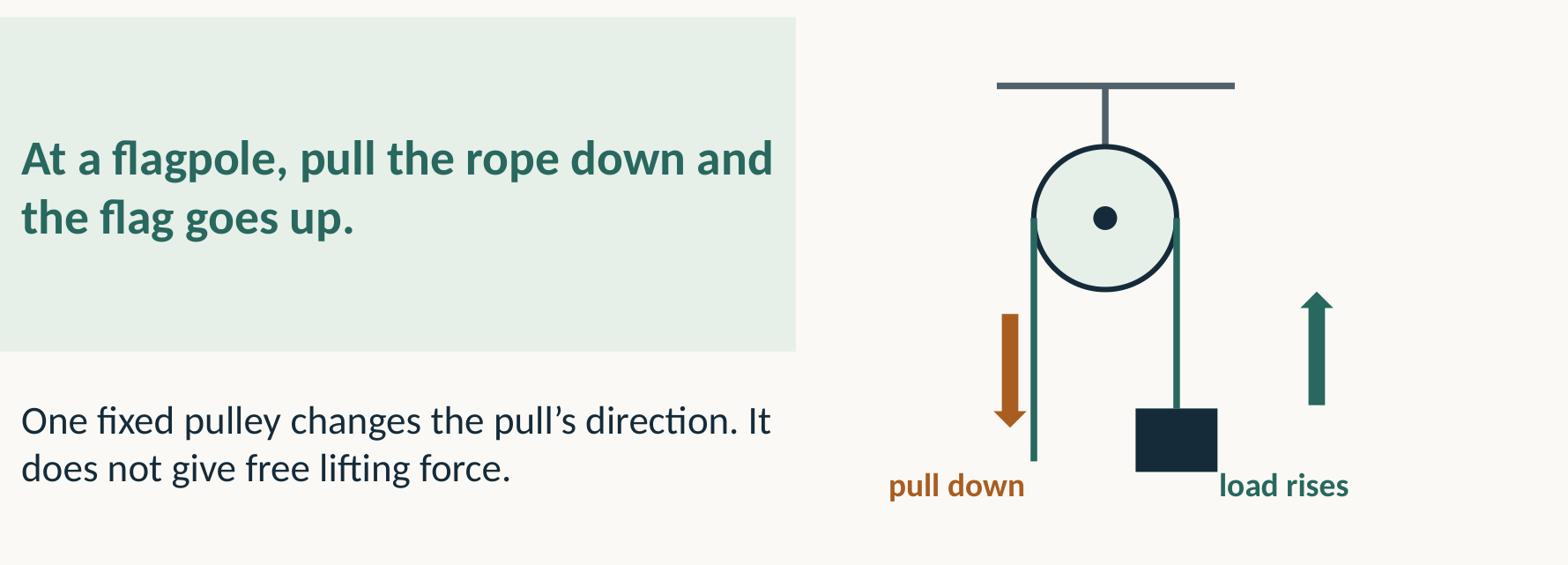
A rope passes over one fixed pulley. Pulling the left rope end down raises the load on the right.
Original teaching-pack diagram and labels.
Open image full size
Read the slide text
A rope passes over one fixed pulley. Pulling the left rope end down raises the load on the right. At a flagpole, pull the rope down and the flag goes up. One fixed pulley changes the pull’s direction. It does not give free lifting force. pull down load rises
Levers, pulleys and gearsSlide 8 of 14
We Do · think togetherGROW · Week 4

Gears trade speed for turning effect

Gears have teeth and pass on turning movement.

A bicycle uses chainrings, a chain and sprockets.

A lower gear can help turn the wheel against a load.

The wheel turns fewer times per pedal turn.

Levers, pulleys and gearsSlide 9 of 14
We Do · think togetherGROW · Week 4

Check the mechanism and its job

MECHANISMEVERYDAY EXAMPLE
Lever Fixed pulley Geared chain driveScissors, wheelbarrow, spanner Flagpole rope over top wheel Bicycle chain and cogs
Levers, pulleys and gearsSlide 10 of 14
I Do · learn and modelGROW · Week 4

Explain the gain and the cost

This is a ___ because ___. It helps by ___, but you have to ___.

Name the mechanism, its job and the trade-off.

Levers, pulleys and gearsSlide 11 of 14
We Do · think togetherGROW · Week 4

Sort the gain and the cost

Less effort force needed

Hand travels farther

Pull down instead of up

Mechanism creates extra energy

Slower turning, greater turning effect

Levers, pulleys and gearsSlide 12 of 14
We Do · think togetherGROW · Week 4

Check your choices

GAIN OR GAIN + COSTCOST OR FALSE CLAIM
Less effort: gain Pull down: direction benefit Slower + stronger turn: bothFarther hand travel: cost Extra energy created: false
Levers, pulleys and gearsSlide 13 of 14
We Do · think togetherGROW · Week 4

Keep both halves of the explanation

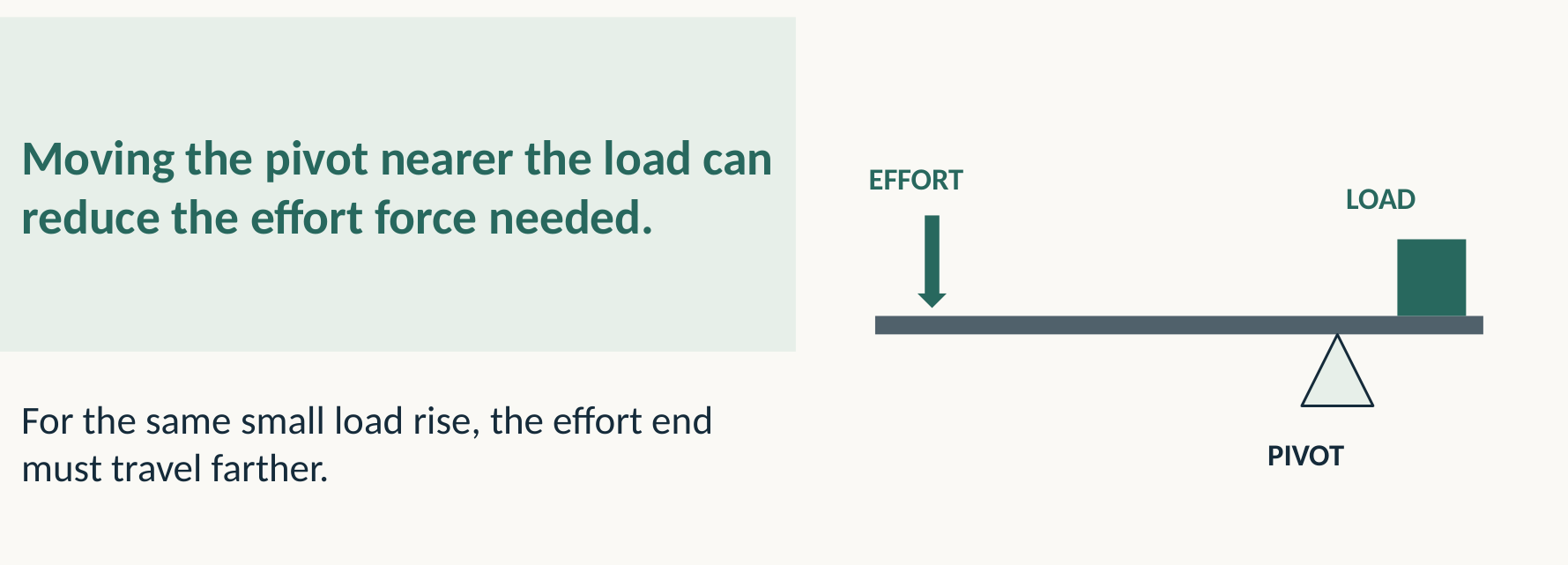
A lever has effort at its far left and load at its right; the triangular pivot is close to the load.
Original teaching-pack diagram and labels.
Open image full size
Read the slide text
A lever has effort at its far left and load at its right; the triangular pivot is close to the load. Moving the pivot nearer the load can reduce the effort force needed. For the same small load rise, the effort end must travel farther. EFFORT LOAD PIVOT
Levers, pulleys and gearsSlide 14 of 14

Use the controls or left and right arrow keys. Printing includes pupil content; model answers remain separate.